Upcoming Events

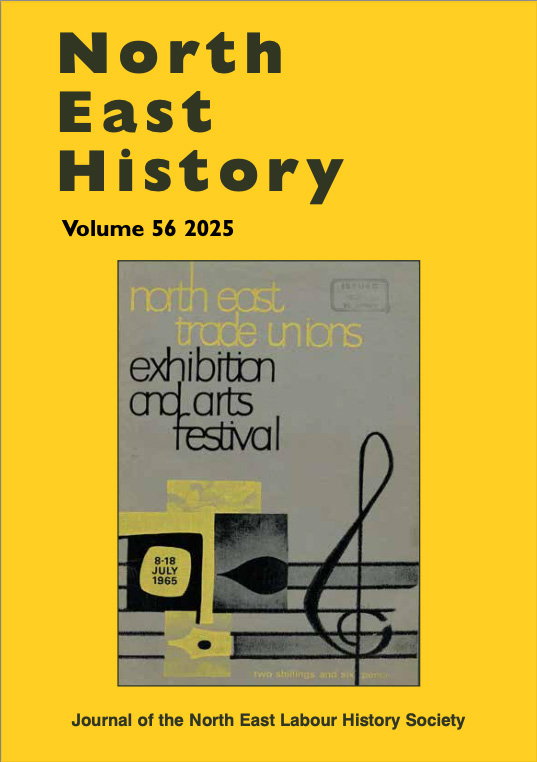
Volume 56, 2025, of North East History Now Avalable

  • It was sixty years ago today…
  • The 1761 Hexam Riot
  • Pit Elegies and Ballads
  • Coal Face: Exegesis
  • The North East Heritage Library: and Interview with Kieran Carter
  • Power to all people?
  • Redhills Renewed: Durham Miners Hall brought back to life
  • The Land of Oak and iron
  • Maureen Calicott: The Story Continued
  • From Our Archive: Labour Women in North East England
  • The Closure of North East Shipbuilders: The Inside Story
  • A Teesside Volunteer in the Lincoln Battalion


For a copy contact

North East Labour History Society Founder’s Award

The Founder’s Award is made annually in memory of our late President Archie Potts.

It is awarded to an organisation, society or group within the region which has, through engagement with its community, most enhanced our understanding of some aspect of the history of working people in 2024. The award is in the form of a framed certificate.

The Society is keen to ensure that all appropriate groups are made aware of the award and the net is spread widely. In the first instance we would like to hear from anyone who feels they know of an organisation to which the award’s remit may apply.

Those wishing to be considered for the award should submit a statement about themselves and their activities in not more than one thousand words. Additional material in the form of press cuttings, photographs etc may be attached. Submissions should be sent to by Monday 31 March 2025.

Battle of Stockton Campaign Group. Winners of the inaugural Archie Potts Founder’s Award

Congratulations to the Battle of Stockton Campaign Group which has won the inaugural Archie Potts founders’ Award. There were five excellent submissions for the award, and Stockton’s was successful. Many thanks to the others who took part.

Here is The Stockton Group’s entry.

Fascism started to take hold across Europe in the early 1930’s. In January of 1933, Hitler was elected as Chancellor of Germany. Not long after this, the divisions that fascism brings became apparent. Looking to Germany and Italy as inspiration, Oswald Mosley established the British Union of Fascists. He hoped to appeal to the working class who were disillusioned with the lack of economic solutions posed by The Labour Party and The Conservatives to combat the effects of the Great Depression. The Battle of Stockton took place on 10th September 1933, when members of the British Union of Fascists (also known as Blackshirts) marched on Stockton High Street in the hope of recruiting new members.  For the Blackshirts, Stockton was seen as an ideal town to recruit new members as it had been hit especially hard by the  of the 1930s and they expected little, if any, resistance.

Instead, they were met with resistance at The Market Cross by 2,000 local people, including members of the National Unemployed Workers Movement, The Independent Labour party, Trade Unionists and members of the Communist Party. Those resisting forced the Blackshirts down Silver Street, back across The River Tees to Thornaby where their buses were waiting for them  No further attempts to carry out a march or rally in Stockton were ever made by the fascists.

Despite the number of people involved, the Battle of Stockton is little-known and rarely talked about, something which the Battle of Stockton campaign is beginning to change.  Formed in January 2018, this volunteer led social history project aims to raise awareness of the battle using a blended approach that engages people in a many different ways.

Working in partnership with Stockton Borough Council a plaque was laid as part of a heritage trail. This trail is 1.3miles and fully accessible and the Council explains that it ‘takes people  around some beautiful buildings and streets that some may not even know exist. A walk for all ages with plenty of places to stop for a lunch or a quick refreshment break’.  It is not possible for BoS to quantify the impact of this trail but the plague – see photo – is the centre piece for activities that commemorate the Battle of Stockton.

There is an annual fundraising concert, based in the Georgian Theatre, featuring local musical acts, spoken word, guest speakers and arts and crafts for children.  Word of the event has spread far and wide and last year one the performers travelled from Milton Keynes to take part. In his words to be part of radical heritage.  BoS estimate that over 500 people have attended the event since it started in 2018 – even reaching people online during the covid lockdowns.

As part of the work BoS has engaged with local choirs. A song has been written by a local artist and its has performed in the town, firstly  as part of a ‘flash mob’, then at the Georgian Theatre and in finally front of a packed house at the Globe Theatre.  During lockdown the 1933 Choir performed – socially distanced of course and this was shared on Facebook.  In the words of the sog, ‘the Blackshirts came and we drove them all away, back to their fascist homes’

With our local partners – a brewery and a micro pub – we created a Battle of Stockton beer, selling it in the Golden Smog.    We estimate that this reached over 250 local people, encouraging some discussion over a welcome pint.

We have sponsored two Basket Ball trophies; competed for by the world’s first micro pub basketball team with community and inclusivity ‘at the heart of our game’. Raising awareness with participants and spectators alike.

Supporting events such as the Durham Miners Gala and local book fairs has helped us spread the word to a wider audience whilst merchandising has seen Battle of Stockton T-Shirts at a number of places including Glastonbury.

This year the group was chosen to host the AGM of the International Brigades Memorial Trust and we were able to use this to not only showcase the Battle of Stockton but also the take pride in the wider history of Stockton on Tees.

Perhaps most importantly the events of 1933 have been brought to life in a film featuring artworks by a number of local Teesside artists. Narrated by actor Marlene Sidaway, this dramatic documentary explores the events of the day, the actions of local people and a sample of life in 1930s Stockton.  It premiered in 2021 and won an award at the Tees Valley Film Festival in 2022.  We estimate that it has been viewed by over 1,000 people.

So what has been the overall effect?   At its most simple we know that many more people are aware of what took place in 1933. Both locally and nationally.  At the last event volunteers set out to engage with people on market day.  The first question they asked was ‘do you know about the Battle of Stockton?’  Many did and were proud of what had happened all those years ago.  Those who did not know have embraced their newly found knowledge of a significant part of Teesside’s proud history.

One of the most significant outcomes of the work the Campaign Group continue to do, would be something our grandfathers who stood against the Blackshirts in 1933 would be proud of. Communities of Teesside are brought together to remember and stand united against the forces that seek to divide us.

Further details about the work of the Battle of Stockton Campaign can be found on Facebook at

https://www.facebook.com/thebattleofstockton

New Articles and Reports on This Site

We have recently added a couple of new articles on our Articles and Reports Page:

So Much has been Lost; Change and Continuity; the NUT in 1970 and the NEU in 2020. Peter Sagar contrasts the state of the education system in the 1970s to the current commodification and rigid control of the curriculum. He discusses the perversions caused by the league tables such as exclusions of weaker pupils to improve exam grade averages. The late 19th century serves as a benchmark for a narrow, arid view of the role of public education, a place we are being taken back to.

In The Newcastle Sailor Who Ended Up An American War Hero Thomas Bagnall tells the story of Sunderland born George H. Bell who served in the US Navy during the American Civil War and, injured in the line of duty, was awarded the United States of America’s highest military honour.

There are also reports on last year’s Peterloo commemorations,  John Charlton’s excellent pamphlet on the Great Newcastle demonstration that followed Peterloo and Dave Temple’s history of the miner’s struggles “From Jarrow to Orgreave”.

Fifteen Past Issues of the Society’s Journal Now Available on this Website

You can now download the whole of issue 1 (1967) and issues 36 (2005) though to 49 (2018) from our Journal pages. This is the first fruit of a decision by the Society to make as many past issues of the Journal available. To access these downloads go to http://nelh.net/the-societys-journal/previous-issues/ and click on the image of the Journal you wish to read.


Matvei Fischer, a Newcastle Old Bolshevik – Paper by David Saunders

Willie Fischer (Rudolf Abel) and his father Matvei Fischer

For those few of you who didn’t make it Professor David Saunders’ terrific Jubilee talk on 7 November 2017 about Matvei Fischer and his son Rudolf Abel (he of “Bridge of Spies” fame), here is a link to David’s 2004 paper about Matvei Fischer.

.

.

Harry Barnes’ Easington Blog

Harry Barnes was Labour M.P. North East Derbyshire 1987-2005. He has been building a blog since 2006 and one of its threads is about Easington and Easington Colliery. There is also a mass of other thoughts and reports which are worth exploring from the Easington link.

Sixty Personal Histories of North East People Now Available on this Website

The North East Labour History Society is pleased to announce that it has published transcripts of the personal memories of sixty people from the North East. You can find these on our website at: http://nelh.net/oral-history/

Do take a look and tell us what you think. If you have transcripts or notes from interviews with people who have been involved in the labour  movement in the North East we would be delighted to provide space for them on our site ().